What Is the NCJUA Fortified Roof Grant?
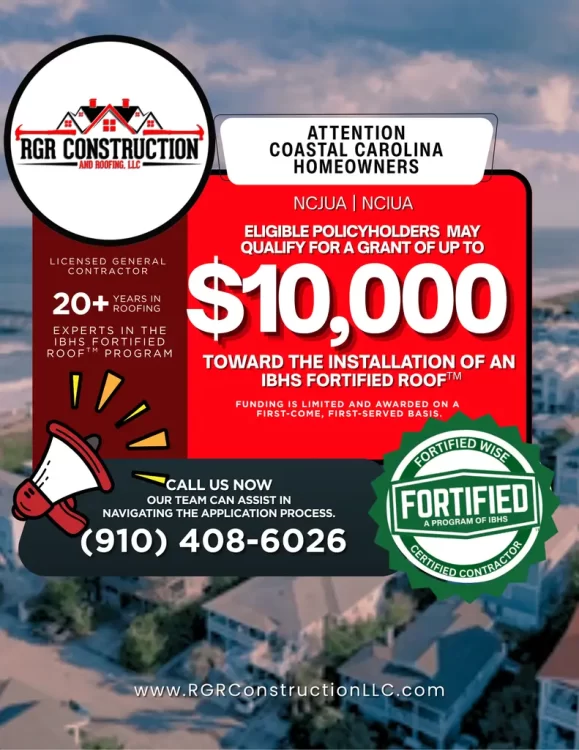
The NCJUA (North Carolina Joint Underwriting Association) Fortified Roof Grant is a program designed to help coastal homeowners strengthen their homes against hurricanes and severe weather. Eligible policyholders can receive up to $10,000 toward installing a FORTIFIED Roof™, a roofing system engineered to exceed standard building codes.
For homeowners in Wilmington, NC and surrounding coastal communities, this grant provides a major opportunity to upgrade your roof while reducing out-of-pocket costs.
What Is a FORTIFIED Roof™?
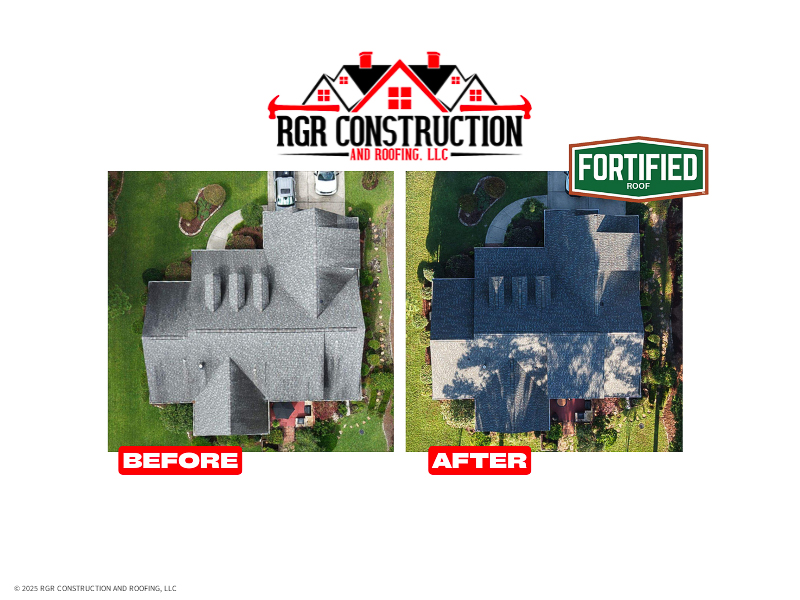
A FORTIFIED Roof™ is a system developed by the Insurance Institute for Business & Home Safety (IBHS) to protect homes from extreme weather conditions common in coastal North Carolina.
Key features include:
- Sealed roof deck to prevent water intrusion
- Enhanced nailing patterns for higher wind resistance
- Reinforced edges and flashing
- Stronger attachment methods for shingles or metal roofing
These upgrades make your roof significantly more resistant to hurricane-force winds, heavy rain, and storm damage.
Who Qualifies for the NCJUA Grant?
To qualify for the Fortified Roof grant, homeowners typically must:
- Have an active NCJUA or NCIUA insurance policy
- Own a home in eligible coastal North Carolina areas
- Upgrade their roof to meet IBHS Fortified standards
- Work with a Certified Fortified Contractor
Funding is limited and awarded on a first-come, first-served basis, so early application is critical.
How Much Can You Receive?
Eligible homeowners may receive:
- Up to $10,000 toward a Fortified Roof™ installation
- Additional savings through potential insurance discounts
This makes it one of the most valuable roofing incentives available in Wilmington, NC.
Step-by-Step: How to Apply
Here’s how the process works:
1. Schedule a Roof Inspection
A certified contractor like RGR Construction and Roofing, LLC evaluates your roof and confirms eligibility.
2. Apply for the Grant
Submit your application through the NCJUA program.
3. Get Approved
Once approved, funding is reserved for your project.
4. Install Your Fortified Roof™
Your contractor completes the installation following strict IBHS standards.
5. Final Certification
A Fortified evaluator verifies the installation and issues certification.
Why Wilmington Homeowners Are Choosing Fortified Roofing
With frequent storms, high winds, and coastal exposure, homeowners in Wilmington, Carolina Beach, Wrightsville Beach, and surrounding areas are upgrading to Fortified systems because they:
- Provide superior storm protection
- Reduce long-term repair costs
- Increase home value
- Help qualify for insurance savings
Why Choose RGR Construction and Roofing, LLC
RGR Construction and Roofing, LLC is a Certified Fortified Contractor serving Wilmington and the Cape Fear region.
We handle everything:
- Grant application guidance
- Full roof inspections
- Fortified Roof™ installation
- Documentation and certification coordination
Our team ensures your roof is built to perform in coastal conditions.
Get Started Today
If you’re searching for:
- roofers Wilmington NC
- roofing companies near me
- Fortified roofing contractor Wilmington NC
- roof replacement Wilmington NC
Now is the time to act before funding runs out.
📞 Call RGR Construction and Roofing, LLC at (910) 408-6026
📍 Schedule your free inspection and see if you qualify
Frequently Asked Questions
The Grant Program
1.What is NCIUA’s Strengthen Your Coastal Roof Grant Program?
A pilot program that will provide grants up to $6,000 for roof replacement with an IBHS FORTIFIED Roof™. This program is open to eligible policyholders with coastal properties located in rating territories 130, 140, 150, and 160.
A limited number of grants are available and will be awarded on a first-come, first-served basis until all available funds have been awarded. You are encouraged to apply as soon as possible to reserve your grant.
2. What is IBHS?
The Insurance Institute for Business & Home Safety (IBHS) is an independent, nonprofit, scientific research, and communication organization.
- What is FORTIFIED?
FORTIFIED is a voluntary construction and re-roofing program designed to strengthen your roof against specific types of severe weather such as high winds, hail, and hurricanes.
4. Where can I learn more about IBHS?
Visit FortifiedHome.org/Research to learn more about IBHS.
5. Why is NCIUA asking survey questions throughout the grant process?
Since this is a pilot program, the NCIUA will use the collected data to design future programs for its policyholders. We have partnered with multiple universities to assist with data analysis.
For example, the North Carolina State University Institute for Advanced Analytics analyzed NCIUA claims data from Hurricanes Dorian, Florence, Matthew, and Isaias. It confirmed that an IBHS FORTIFIED Roof™ increased the resiliency of a home and, when the home was damaged, reduced the severity of the damage.
NCIUA is also working with the following universities to assist with research on disaster mitigation, construction, resilience, preparedness, and grant effectiveness: North Carolina State University, East Carolina University, University of North Carolina at Chapel Hill, Appalachian State University, University of Delaware, and University of California. None of these institutions are charging for their time or effort.
The Grant
- Will I get $6,000?
The grant maximum is $6,000. If your application is approved, NCIUA will reserve up to $6,000 toward the installation of an IBHS FORTIFIED Roof™. However, if the entire cost of installing the roof is less than $6,000, the grant amount will be limited to the total cost of the roof and will be paid upon completion of the roof replacement and receipt of the IBHS FORTIFIED Roof™ designation certificate.
- Is the grant taxable?
Grant funds are currently considered taxable income. As such, the policyholder is responsible for any tax obligations resulting from receipt of the grant. NCIUA requires a completed IRS Form W-9 from the policyholder to obtain their taxpayer identification number. Policyholders are encouraged to consult a tax advisor to fully understand any tax implications.
NCIUA remains committed to supporting and advocating for federal legislation that would exempt North Carolina residents from federal and state income taxes on Strengthen Your Coastal Roof grant funds received through this state-based program.
Eligibility
Who is eligible to receive a grant?
This pilot program is limited to policies written by the North Carolina Insurance Underwriting Association (NCIUA).
NCIUA policyholders who have Homeowners, Homeowners Windstorm or Hail, or Dwelling Windstorm or Hail policy with Coverage A (Building coverage) on property along the coast (rating territories 130, 140, 150, and 160) meet initial eligibility to receive a grant. Policyholders must have a current, eligible policy that was effective on or before June 1, 2025.
Policies written by the North Carolina Joint Underwriting Association (NCJUA) / FAIR Plan Dwelling Full Peril policies for the Grant Program.
What areas are included in rating territories 130,140,150, and 160?
Rating territories are established by the North Carolina Rate Bureau. In general, these territories include the following counties: Beaufort, Brunswick, Camden, Carteret, Chowan, Craven, Currituck, Dare, Hyde, Jones, New Hanover, Onslow, Pamlico, Pasquotank, Pender, Perquimans, Tyrrell, and Washington, except that “Coastal Area” does not include the portions of these counties that lie within the Beach Area, all as specified in G.S. 58-45-5(2b).
Who determines eligibility?
NCIUA determines initial eligibility for the Strengthen Your Coastal Roof Grant Program based on policy type, property location, and eligibility guidelines. IBHS will determine if the home is eligible for an IBHS FORTIFIED Roof™.
What dwelling types are eligible?
The FORTIFIED Home program is only applicable for the residential, single-family, and two-family dwelling types listed below. Note that this list is not all inclusive and each building’s unique attributes determines eligibility.
- Single-family detached home — a freestanding residential building occupied by one family. Limited to three stories above grade. This also includes detached single-family factory-built modular homes that are designed, built, and sited to meet all local building code requirements.
- Two-family dwelling units (duplex) — a freestanding residential building occupied by two families. Limited to three stories above grade. NOTE: The entire two-family building, which includes both dwelling units, must be evaluated under the appropriate FORTIFIED requirements and the entire building must meet all requirements for the designation being considered. Individual units are NOT eligible for designation unless the entire building is being designated.
- HUD manufactured homes — a single-family residential home manufactured to HUD’s Zone II or Zone III Manufactured Home Construction and Safety Standards adopted after July 1994. The home must be sited on and properly attached to a permanent foundation (see foundation requirements in Section 1.2.3.3). HUD manufactured homes built before July 1994, and Zone I homes built after July 1994, are NOT eligible.
- Townhouse — a single-family dwelling unit constructed in a group of three or more attached units in which each unit extends from foundation to roof and has a yard or public way on not less than two sides. Limited to three stories above grade. Mixed use (commercial and residential) buildings are NOT eligible. NOTE: The entire townhouse building, which includes all townhouse units composing the building, must be evaluated under the appropriate FORTIFIED requirements and the entire building must meet all requirements for the designation being considered. Individual townhouse units are NOT eligible for designation unless the entire building is being designated. Example: A four-unit, two-story townhouse with all units attached is eligible for a specific FORTIFIED designation only if the entire building, including each and every townhouse unit, is evaluated and all units meet the requirements for that designation.
For more information on IBHS’ Eligibility requirements, visit the IBHS website FortifiedHome.org/technical-documents/.
Are mobile homes and manufactured homes eligible?
Not all mobile or manufactured homes are eligible. To qualify, a home must meet specific criteria, including being constructed after July 1994 and complying with IBHS foundation and building requirements.
IBHS FORTIFIED ROOF™
How is an IBHS FORTIFIED Roof™ different from a normal roof?
An IBHS FORTIFIED Roof™ meets a specific standard, which was designed after decades of research, to provide greater protection from natural disasters.
****Roof damage often begins when wind gets underneath the roof edge and rips it away from the home. To help protect this vulnerable area, FORTIFIED requires specific materials and installation methods, including a wider drip edge and a fully adhered starter strip, that when used together create a stronger system.
If wind rips off roof covering (shingles, metal panels, or tiles) it exposes the wood beneath and allows water to pass through the gaps and enter your home. FORTIFIED requires roof decks to be sealed to prevent this type of water damage.
Instead of common smooth nails, FORTIFIED requires ring-shank nails, installed in an enhanced pattern, to help keep the roof deck attached to the home in high winds. In fact, using ring-shank nails nearly doubles the strength of the roof against the forces of winds.
For more information: Visit the IBHS website https://FortifiedHome.org/Roof/.
What are the advantages of an IBHS FORTIFIED Roof™?
- Strength: Superior performance during severe weather
- Savings: Insurance premium discounts
- Value: Research suggests enhanced resale value
- Security: Comfort knowing that your roof is built to higher standards
What is an IBHS FORTIFIED Roof™ Designation?
An IBHS FORTIFIED Roof™ designation is an official certification confirming that a home or business has been constructed, renovated, or re-roofed in accordance with FORTIFIED standards. Issued by the Insurance Institute for Business & Home Safety (IBHS), the designation is granted after a certified FORTIFIED Evaluator submits documentation and it undergoes review. This designation is required to receive grant payments, qualify for FORTIFIED insurance discounts, and obtain mitigation credits.
How long does a designation last?
An IBHS FORTIFIED Roof™ designation is valid for five calendar years. At the end of this period, a re-designation inspection is required to maintain the current designation level for the home or business. If no significant structural changes have been made and the roof covering remains within its expected lifespan, the designation may be renewed for an additional five years.
How to Apply
How can a policyholder learn more or apply for the grant?
The policyholder can visit or call the dedicated NCIUA staff at 1-877-GRANTNC (877-472-6862).
When will I receive the money from the grant?
NCIUA Grant Team – NCIUA will distribute grant funds to the policyholder only after the following have been submitted to the Association: (1) the IBHS FORTIFIED Roof™ designation certificate, (2) a final invoice from the contractor, and (3) a completed W-9 which provides the policyholder’s taxpayer identification number (or other necessary tax information).
Will all applications be approved?
Some homes are not eligible for the grant program based on SYCR program rules and IBHS construction requirements. For example, homes with significant damage to roof structural members, un-reinforced foundations, or pest damage are not eligible.
In some cases, a pre-inspection (at no cost to the policyholder) may be required to determine eligibility for the program. Cathedral ceilings, roof decks, solar panels, and modular home foundations are some examples that may require pre-inspection.
These examples are not exhaustive. IBHS makes final construction eligibility determinations.
If a grant application is approved, how long does the policyholder have to install an IBHS FORTIFIED Roof™?
The new IBHS FORTIFIED Roof™ must be installed by construction deadline date. Once the policyholder has submitted all required documentation, the grant funds will be distributed.
What documents are needed to process the grant payment after the IBHS FORTIFIED Roof™ is successfully installed?
After the IBHS FORTIFIED Roof™ is successfully installed:
- The evaluator will submit the IBHS FORTIFIED Roof™ designation certificate.
- The contractor will submit the final invoice via the website dashboard.
- The policyholder will submit a completed W-9 form on the Strengthen Your Coastal Roof website.
Call RGR Construction and Roofing, LLC for assistance with the application process, as certified FORTIFIED we understand the process, and can answer any questions you may have. For assistance from RGR Construction and Roofing Call: (910) 408-6026